

Based in
New Delhi ,India
Mediums
Themes
Education
Selected Exhibitions
Mixed media painting, textile assemblage (katran), acrylic painting, drawing, hand stitching
Womanhood, identity, memory, resilience, material culture, social visibility
2023: BFA (Applied Art), College of Art, University of Delhi;
2023: MA Visual Communication (Distinction), University for the Creative Arts, Canterbury, UK.
2024: PhD in Design (ongoing), Karnavati University, Gujarat
December 2026: Art Presentation / Exhibition, Lalit Kala Akademi, Chennai, India
November 2026: Installation Presentation, Abhiviyakti Art Festival, Gujarat, India
May 2026: Exhibition in collaboration with Kaarigiri Foundation, Aparna Kaur Gallery, New Delhi, India

Rhizoscape: The Living Network exhibition in London will be showcasing some of this artist’s work from 19th February to 4th March 2027
Shinjini Awasthi
Multidisciplinary painter transforming discarded textile into narratives of womanhood, memory and dignity.
Shinjini Awasthi uses katran, discarded fabric remnants, to examine how women are seen, valued and remembered. Stitching textiles into painted surfaces, she gives fragments of cloth a new life while drawing attention to the labour and histories they carry. Across Object of Pleasure, The Audacity and Widows of Vrindavan, visibility shifts from exposure to self-possession. The works ask who has the power to look, and whose identity is allowed to endure beyond the roles society assigns.
Shinjini Awasthi is an Indian multidisciplinary artist, designer and educator based in New Delhi. She holds a BFA from the College of Art, University of Delhi, and an MA in Visual Communication, with distinction, from the University for the Creative Arts in Canterbury. She is pursuing a PhD in Design at Karnavati University and is an Assistant Professor of Visual Communication at Amity University, Noida. Her work has been exhibited in New Delhi and London.
Practice Themes
Material as Memory
Katran, the discarded fabric remnants Awasthi stitches into her painted surfaces, carries the labour and histories of the women who handled it. In her work, cloth holds memory
From Exposure to Self-Possession
Across Object of Pleasure, The Audacity and Widows of Vrindavan, visibility shifts from being displayed to being claimed. The women in these works are not only looked at. They assert their own presence.
Who Endures
The works ask who has the power to look, and whose identity is allowed to last beyond the roles society assigns. They give lasting dignity to women too often pushed to the margins of public life.
Her practice combines painting, drawing, hand stitching and textile assemblage to explore womanhood, identity, memory and material culture
-
December 2026: Art Presentation / Exhibition, Lalit Kala Akademi, Chennai, India
November 2026: Installation Presentation, Abhiviyakti Art Festival, Gujarat, India
May 2026: Exhibition in collaboration with Kaarigiri Foundation, Aparna Kaur Gallery, New Delhi, India
March 2026: Exhibition in Artizan Gallery, New Delhi, India
2024: Exhibition / Art Presentation, UCA Canterbury, UK
The Works
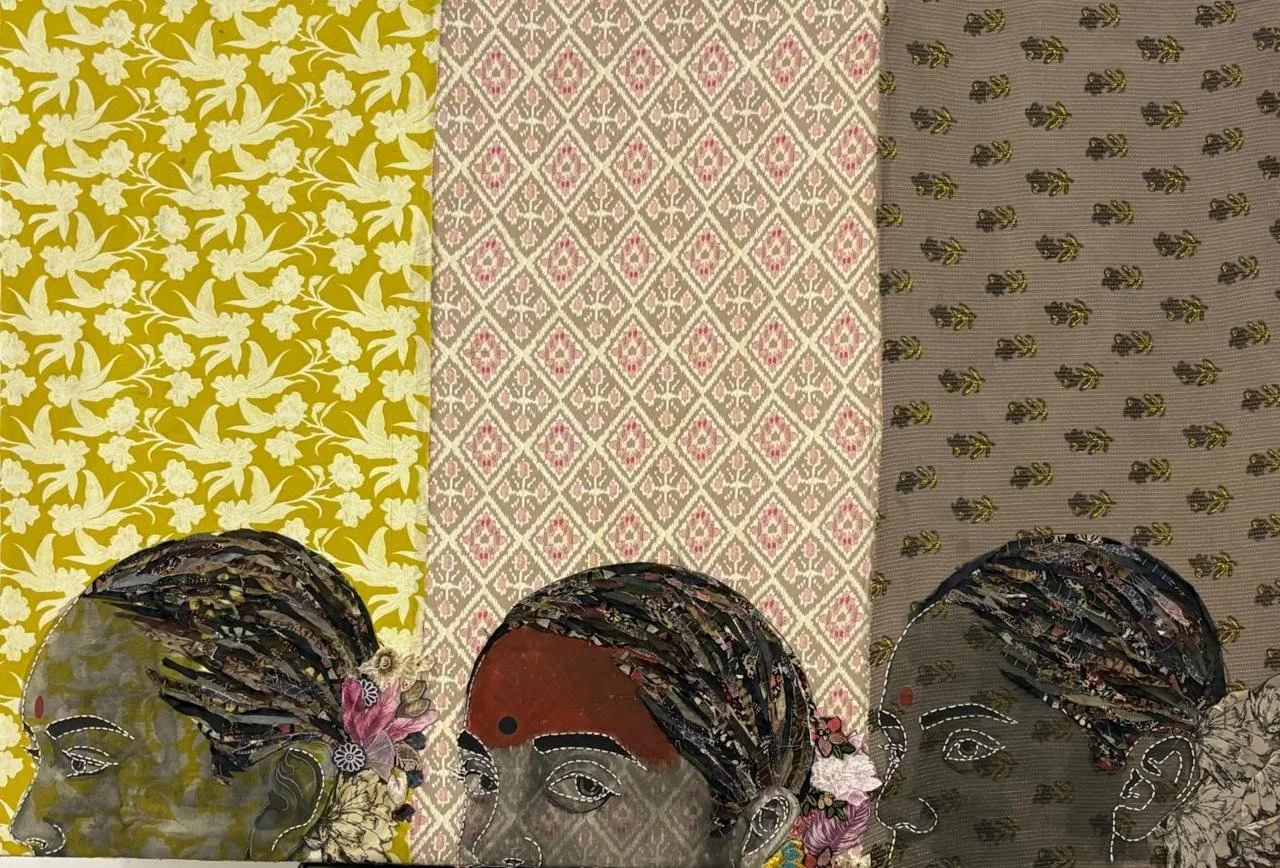
Shinjini Awasthi
Mixed media on canvas
2025
139.7 by 94 cm. ; 55 by 37 in.
Price: POA
The Audacity explores the simple yet powerful act of a woman meeting another’s gaze. Three women stand together, two avert their eyes, while the third looks directly at the viewer. In many communities, eye contact from women is considered disrespectful, shameless, or defiant, reducing even the act of looking into someone’s eyes to a form of disobedience.
The woman who returns the viewer’s gaze embodies courage and self possession. Her unwavering stare becomes an act of quiet resistance, challenging the social expectations that demand women remain unseen, unheard, and submissive. Through reclaimed textiles, the work reclaims not only discarded material but also the right of women to be visible, acknowledged, and unafraid to meet the world on their own terms.
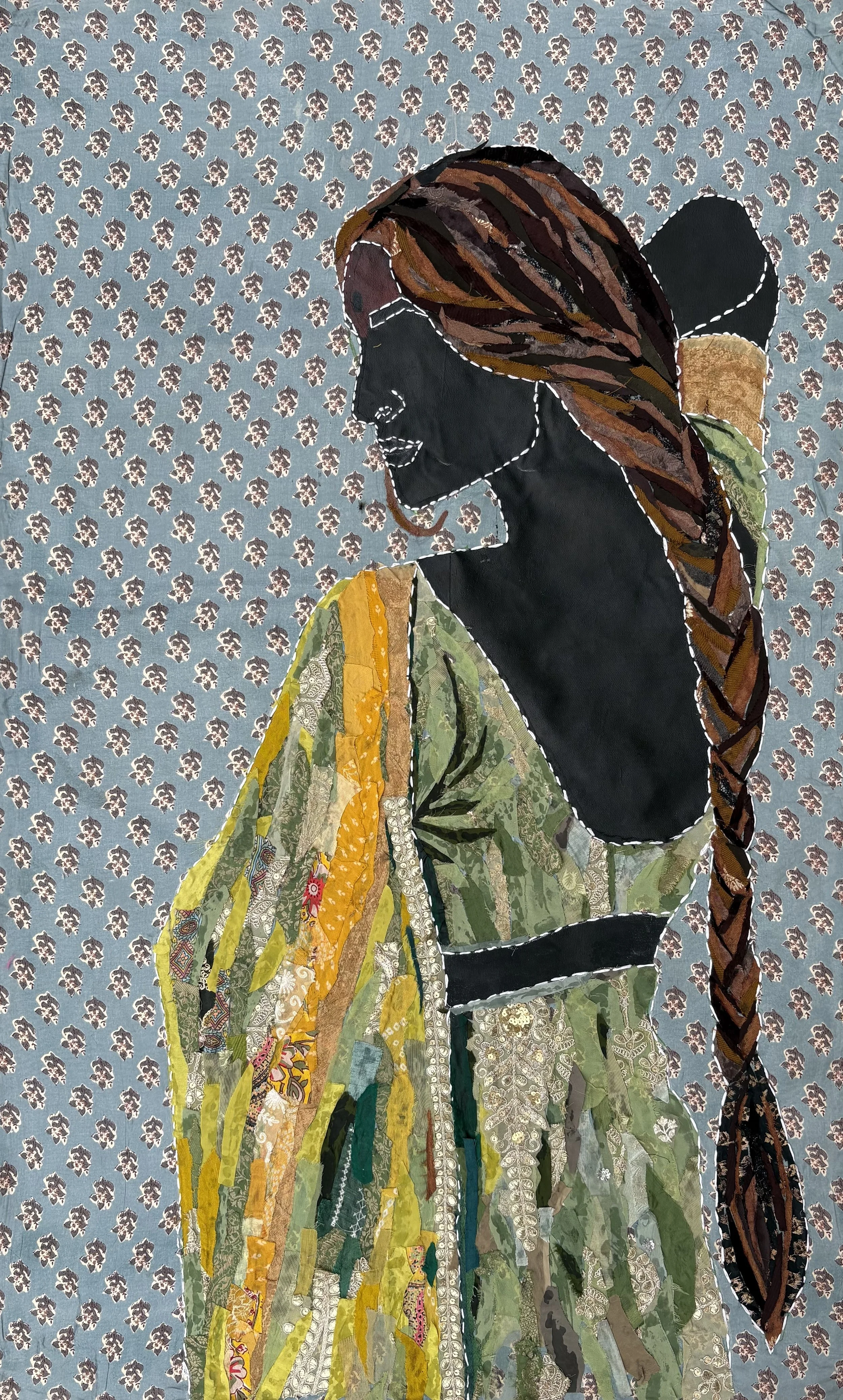
Shinjini Awasthi
Mixed media on canvas
2022
92.7 by 111.8 cm; 36.5 by 44 in.
Price: POA
Object of Pleasure depicts an abstract Indian woman with a visible face, yet without eyes. She represents any woman moving through daily life, seen but never truly acknowledged. The absence of eyes reflects how society denies her subjecthood, choosing to sexualise her body rather than recognise her humanity. She is looked at, desired, and reduced present, yet deliberately unseen.
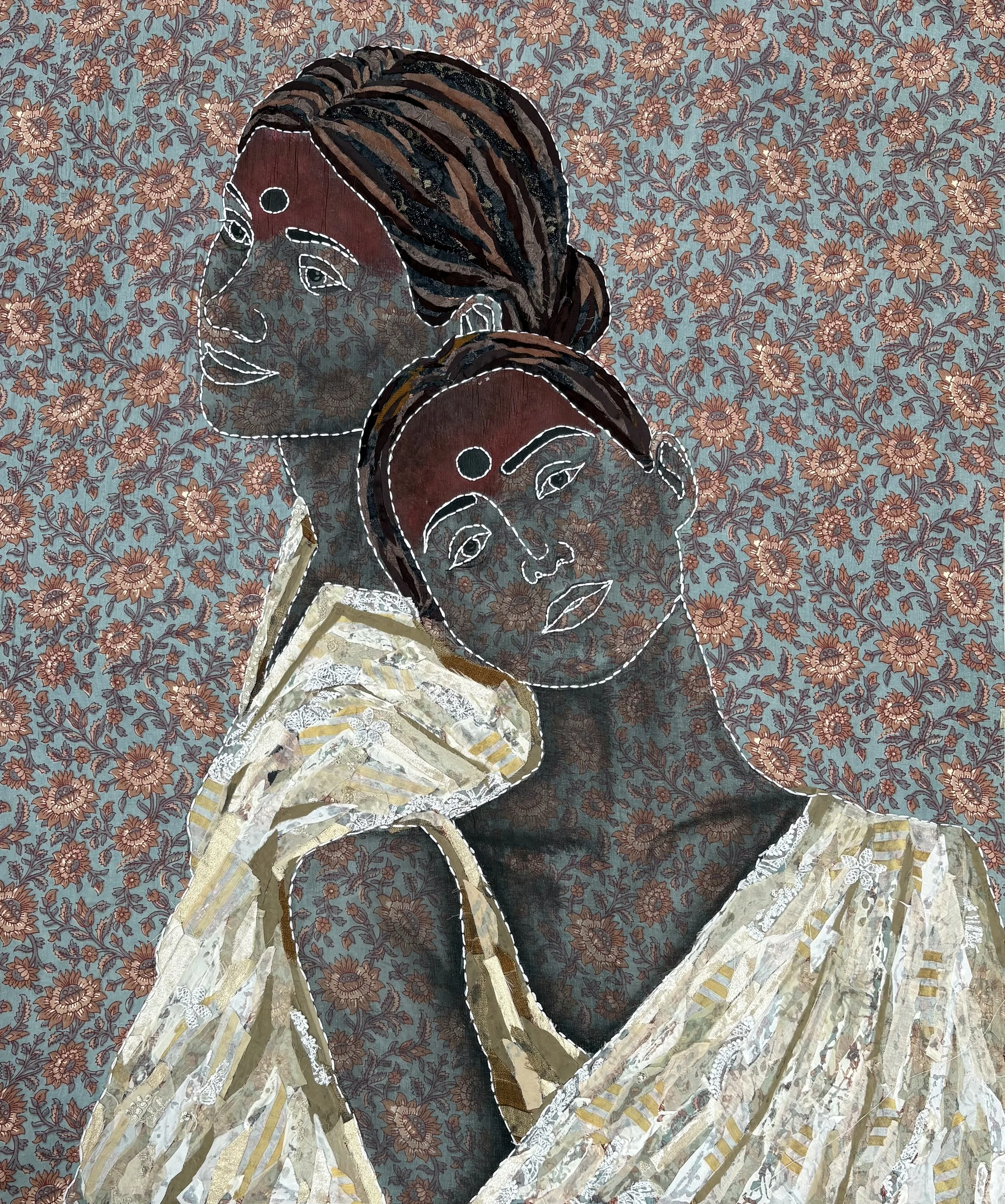
Shinjini Awasthi
Mixed media on canvas
2022
114 by 94 cm.; 45 by 37 in.
Price: POA
Widows of Vrindavan portrays two young women seen begging on the streets of Vrindavan, figures society has stripped of dignity, identity, and place. In the painting, they appear dark, echoing the form of Maha Kali, a goddess often misunderstood as terrifying, yet profoundly powerful. Like Kali, these women are reduced to darkness by social fear and exclusion, expected to live without colour, desire, or voice.
Though denied respect and visibility, their divinity remains intact. The world may erase their social worth, but it cannot touch their spiritual presence. This work confronts how holiness and suffering coexist, revealing that what is cast aside as impure or unwanted may, in fact, carry immense sacred power